Cito Lab Company Visit
About this event
- Category
- Professional Development Events
- Organizer
- Board & Coord
- Date and time
- Apr 29, 2026 11:00 - 20:15
- Location
- Arnhem
- Participants
- 11 participants
SIGNUP IS FULL (NEW SIGNUPS WILL BE PUT ON THE WAITING LIST)
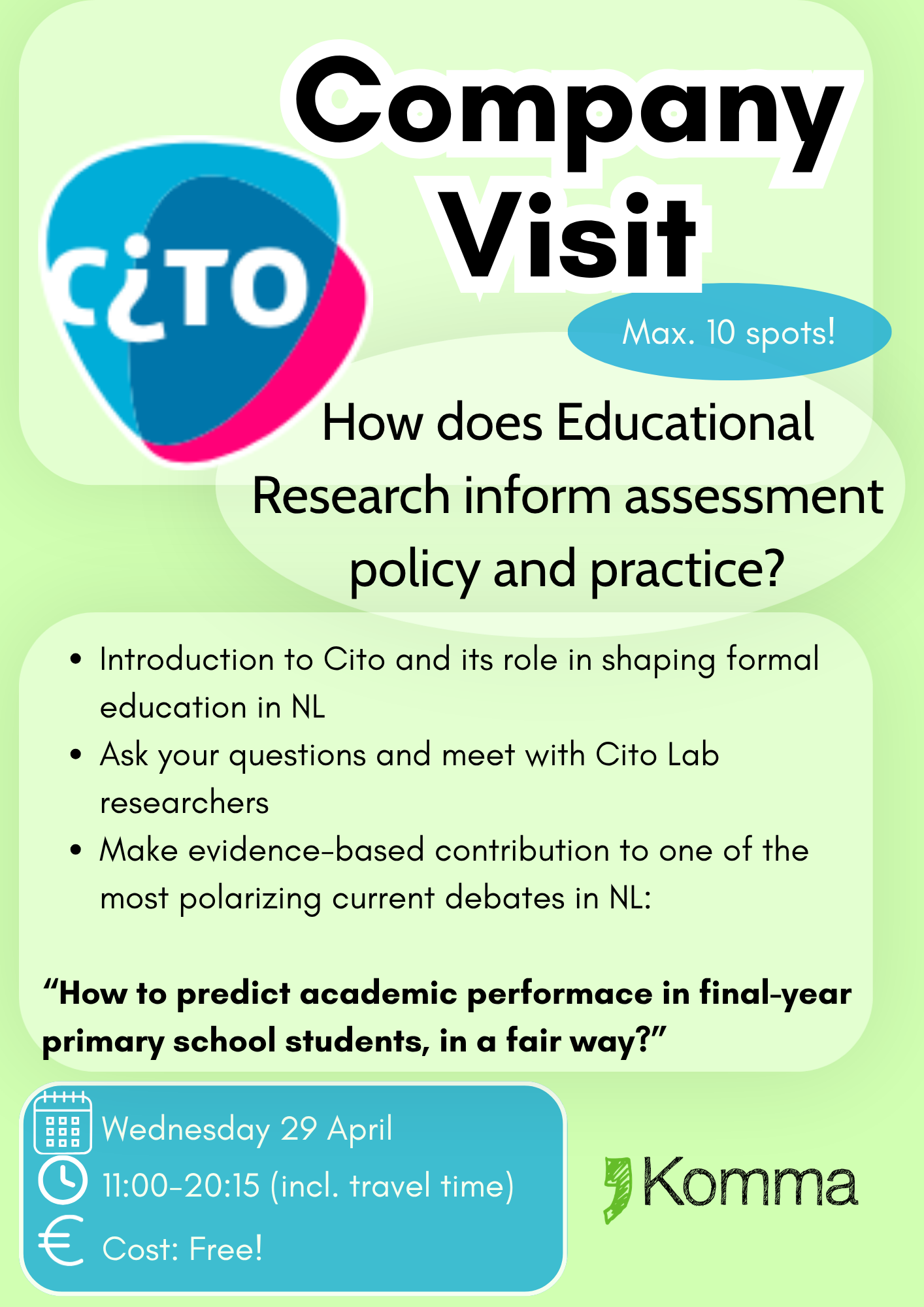
Join us for a visit to Cito Lab, the research and innovation department of Cito on Wednesday April 29.
**Please read all information before signing up**
Cito is best known for creating assessments that all children take at the end of primary school to help determine their secondary school placement. But did you know that they also create many more standardized assessments (e.g. secondary school final exams), and use educational research to advise law and policy making?
During the visit we will discuss an important and timely question: how can different types of information about a group8 pupil (high and lowstakes test results, teacher observations, etc.) be weighted and combined to arrive at a wellfounded recommendation for the transition to secondary education (roughly: vmbo, havo, vwo)?
Program
-
11:00: Meet at Enschede train station
-
11:15 - 12:50: Arrive in Arnhem (office is located next to Arnhem train station)
-
13:00 – 13:45: Presentation about Citolab — who we are and what we do
-
13:45 – 14:30: Smallgroup work on the question
-
14:30 – 15:00: Plenary discussion and presentations
-
15:00 – 15:30: Closing coffee with Citolab colleagues
-
15:30 - 18:30 Free time in Arnhem (or travel home at your own cost)
-
18:30 - 20:15 Travel back to Enschede together
Background
The transition from primary to secondary education is a key moment in the Netherlands: at a relatively young age (11/12 years) pupils are placed into different tracks within secondary education. Although there is theoretically room to move between tracks later on, many pupils tend to remain in their initial placement, which affects their subsequent schooling and opportunities.
In addition to the school’s provisional recommendation, the doorstroomtoets (transition test) plays an important role in determining the final recommendation. There are currently six providers of transition tests (AMN, Diataal, Bureau ICE, Cito B.V., AVISION and the DOE test offered by the national government, developed by foundation Cito). If a transition test results in a higher recommendation, the school is generally required to raise its recommendation accordingly, unless it provides a motivated reason not to.
Why this topic?
There has long been dissatisfaction with aspects of the current system, for example:
-
substantial differences between tests that can lead to systematically higher or lower recommendations;
-
criticism that the tests are too narrow in scope (focused mainly on maths and a limited part of language);
-
resistance to the obligation to revise recommendations upward following a higher test result.
On 11 December 2025 the Dutch House of Representatives discussed the transition test in a plenary debate, addressing the test’s form, function and content as well as the organization of the system. The State Secretary aims to move to a single transition test around 2029–2030; the sector (POraad, VOraad) would prefer this to happen sooner. The coming years are therefore a period of uncertainty and interest for schools, test providers and other stakeholders.
At Citolab we are preparing for potential changes and want to be an informed discussion partner. Questions we are exploring include: which additional skills might be relevant to measure and how? What other information sources could be used in the PO→VO transition? And if you have multiple sources, how can they be combined into a coherent recommendation?
Preparation for participants
It is helpful to prepare in advance. Possible angles:
-
If you did not attend primary and secondary school in the Netherlands: how is the transition organized in your country? When does selection happen and on what basis? How is the system perceived? What are potential risks?
-
If you have experienced the group8 (primary to secondary school) transition during an internship or work placement: what was the sentiment at the school? What do staff think works well or poorly? What concerns do they have?
-
Reading: Meehl’s classic 1954 work on subjectivity in (clinical) decisionmaking is also relevant for educational decisionmaking. What do you make of his findings? Are there later studies that nuance or contradict his conclusions?
Practical preparation:
- Bring lunch to have on the train
- Please indicate whether you want to take part in the group ticket, or you have your own ticket
- We will create a group chat to coordinate travel max. 1 week in advance. If you haven't been added a few days before the event, please reach out to the board!
Participants
Please login to view all participants
Comments
Log in to read and post comments